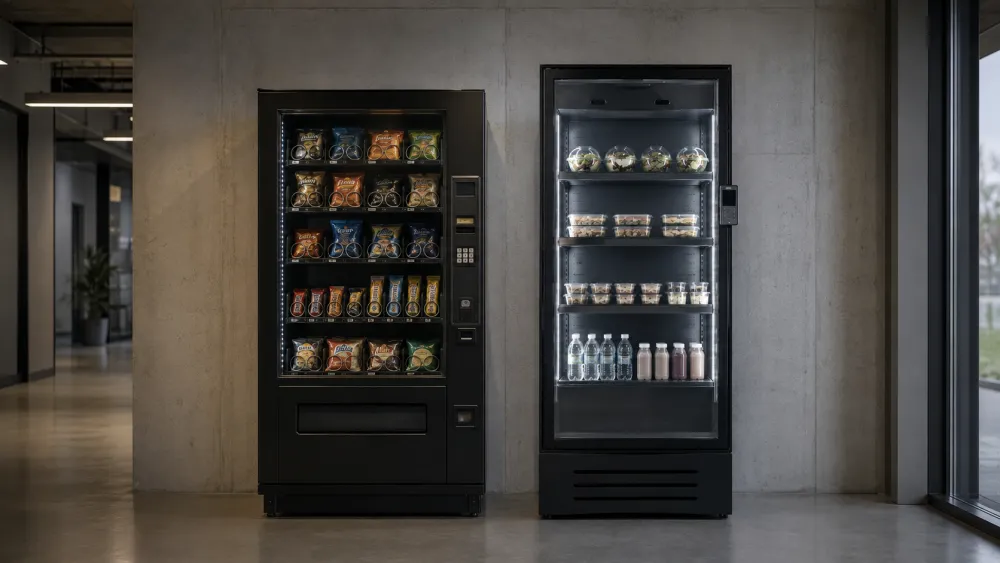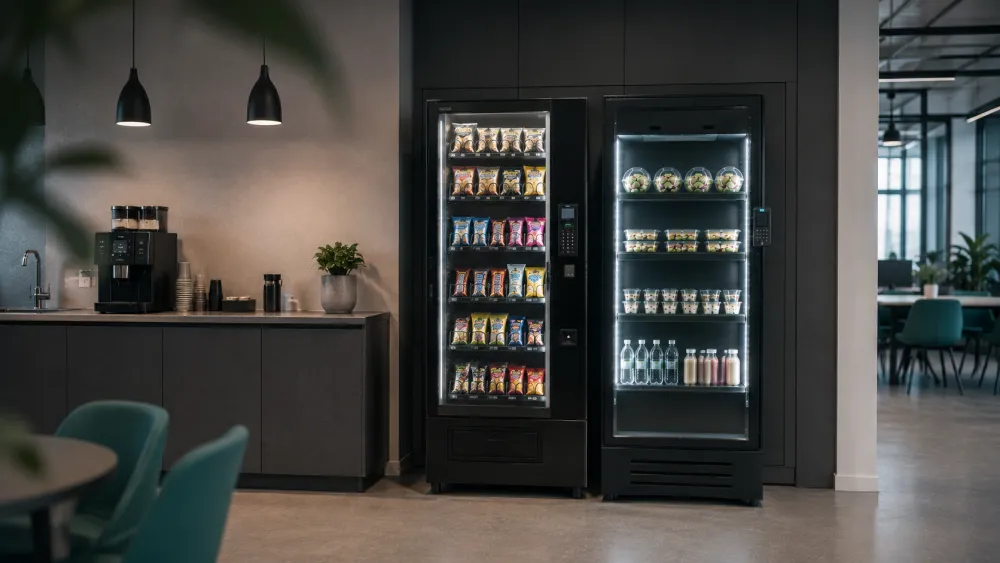
A micro market is a small shop without staff: open shelves, chilled units and a kiosk where people scan and pay themselves. A smart fridge does the same in half a square metre, with a door that only opens after payment. Which of the two suits you depends on space, control and how many people you have.
The idea of a micro market appeals: people walk in, choose from shelves and pay at a kiosk. It feels more like a shop than a vending machine. In large offices and shared buildings, such as a coworking space, it is often considered for that reason.
An open set-up does ask for something: a closed room or a spot in plain view, enough people to keep the shelves turning, and trust that everyone pays at the kiosk. A closed cabinet does not ask for that, because it only opens once it knows who is taking something.
| Micro market | Smart fridge | |
|---|---|---|
| Space | A corner or room with shelves and a kiosk | About half a square metre per cabinet |
| Control | Payment relies on trust at the kiosk | The door only opens after payment or identification |
| Range | Wide, if there are enough people | Focused: what actually sells at your site |
| Chilling and data | Spread over several units | One cabinet, temperature and sales monitored continuously |
| Expanding | More shelves in the same room | A second cabinet in another spot |
What is monitored in a chilled cabinet from kitchen to hand is covered in food safety in the vending machine.


With lots of people in one place, a room you can fit out and a setting where paying on trust works, a micro market offers more choice than one cabinet. We do not build them, and we would rather say so straight away. On large sites, a series of cabinets by the break areas is a middle way; see smart fridge for a large company.
If you are considering it to replace a canteen, first read what a cabinet does and does not take over in an alternative to a staff canteen. What a cabinet costs per option is in what a smart fridge costs.
No. We make closed, chilled cabinets that you buy, rent or lease. If you are looking for a complete self-service shop with shelves and a kiosk, another supplier is better placed.
For some buildings, yes: it feels more like a shop. A smart fridge has a glass door, so people see what is inside and can choose at their own pace. The biggest difference lies in space and control.
An open set-up relies on people paying at the kiosk. Where many different people pass through, that is a risk whoever runs it has to allow for. With a closed cabinet, the door only opens after payment or identification.
At many sites, yes, especially when people are spread over floors or halls. Two cabinets on two walking routes are often used more than one shop people have to go out of their way for.
That depends on the fit-out. A smart fridge holds dishes kept chilled and heated in a microwave next to it. The same principle applies to an open set-up.
Eight short questions about your building and your people. We tell you whether a closed cabinet is enough at your site.
Takes about 90 seconds · no obligation · no contact details until the last step