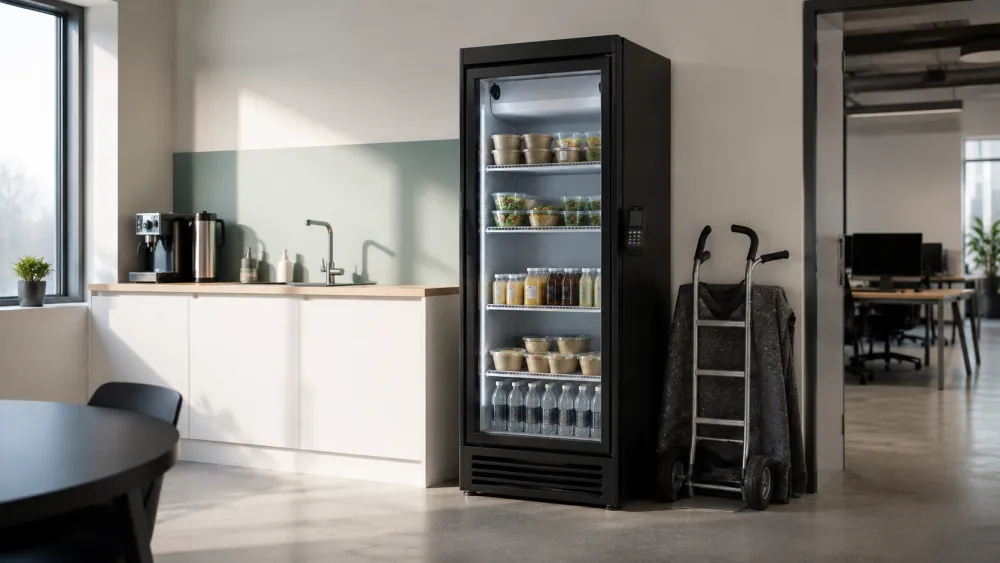
No purchase price, a predictable fee and no ownership risk: that is what most businesses are after when they think of renting. Here is how renting and leasing differ, what is included and what you still need to organise.
People searching for “rent a smart fridge” are rarely after the machine itself. They want no up-front investment, a predictable cost and no risk if it does not take off. That is a fair question, the same as with a vending machine that costs you nothing. Behind it there is often a more concrete problem: no canteen on site, a canteen that has become too expensive and needs an alternative, or nobody has time to organise food for staff.
Whether you rent or lease, the unit is there, but restocking, rotating fresh products and following up still need organising, by you or a supplier. That is the part that comes back every week, and it decides whether the fridge works. Agree who does it before the unit arrives.
The unit is the same every time. What differs is who owns it and how the cost is spread over time.
| Rent | Lease | Buy | |
|---|---|---|---|
| Up-front investment | None | None | Yes, you buy the unit |
| Owner during the term | The rental company | The finance company | You |
| What you pay | A fee for the use | Instalments that spread the cost | The purchase price |
| At the end of the term | Return or extend | Depends on the contract | The unit stays yours |
| Restocking | You or your supplier | You or your supplier | You or your supplier |
| Suits | A trial or a short term | Long term without tying up capital | Those who want the unit and the margin |
Want to own the unit? See what buying involves and what maintenance covers. Already have a vending machine? Organising restocking well is often the quickest improvement.

Rented or leased, a fridge is only as good as what is in it. You choose the supplier.
Proper dishes, enough to get through a break or a night shift.
High-protein meal preps, salads and lighter options, next to the usual snacks and drinks.
A halal, kosher or vegan range next to the rest, or a fridge stocked entirely that way. On many sites, use depends on it.

Yes: instead of a purchase price you pay a fee over an agreed term, and the unit is delivered, commissioned and supported remotely. Restocking is done by you or your supplier.
When you rent, you pay for the use of the unit and the rental company stays the owner. Leasing is a form of finance that spreads the cost of the unit, usually through a finance company; what happens at the end of the term depends on the contract. Day to day, the fridge works exactly the same.
Term and notice are agreed per site, in advance and in plain language. We do not hold anyone to a site where it clearly does not work. That is why the site check first looks at whether a fridge makes sense for you at all.
That can be discussed. Some companies rent first to see whether it takes off, then buy. The options depend on the contract.
That depends on the option, the term, the configuration and your site: headcount, hours and range. So we only give a figure after the site check, which is free and without obligation.
Eight short questions about your site, then we call you back with a concrete proposal to rent, lease or buy.
Takes about 90 seconds · no obligation · no contact details until the last step