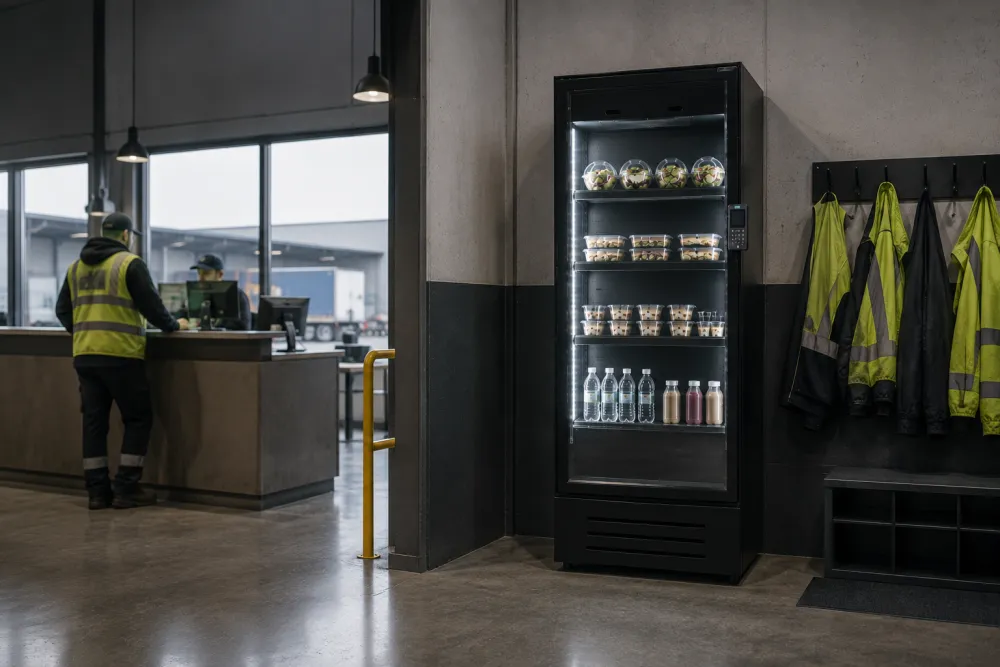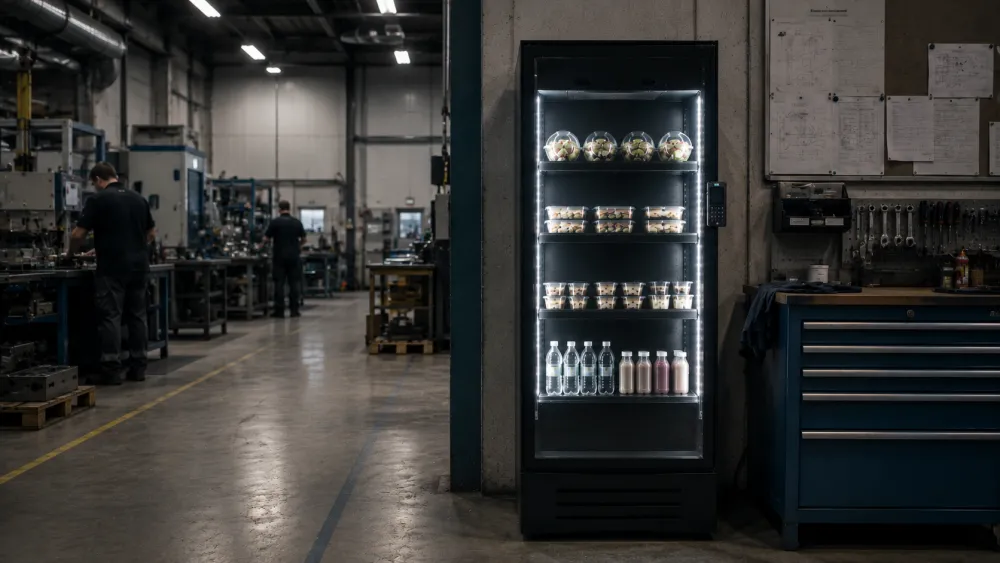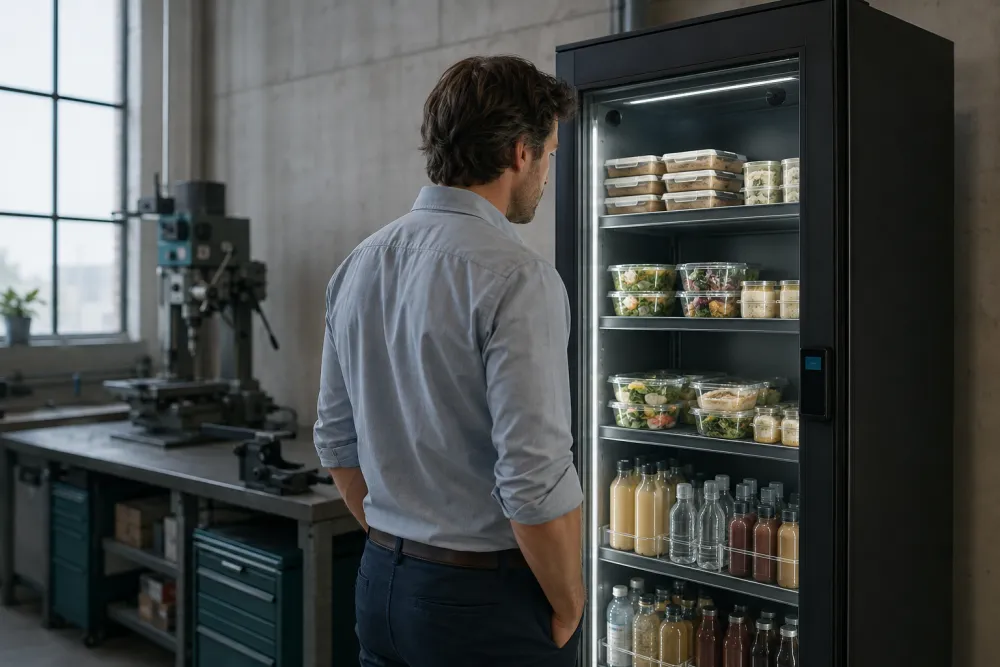
At three in the morning the canteen is closed, the sandwich shop is closed and the petrol station is a twenty-minute drive. A smart fridge on the floor itself is often the only thing still providing food at that hour, and a shift notices straight away.
In a warehouse, a production hall or a dispatch area, work carries on while everything around it closes. The canteen runs on office hours or does not exist. Whoever is hungry takes the car, or does not eat. For a late shift that is half an hour of productivity; for a night shift it is a reason to work somewhere else.
A smart fridge on the floor changes that without building a kitchen. It stands where people work, opens after payment or identification and holds real meals next to crisps and soft drinks. It needs a socket and about half a square metre, nothing more.

Large sites, early and late shifts and rarely anything to eat within walking distance. Often the sites where a fridge pays off fastest. See also smart fridge for warehouses.
Continuous shifts and fixed break windows. The fridge stands by the break room and covers exactly those twenty minutes. Worked out for manufacturers.
Maintenance crews, on-call staff and response teams who come in at unpredictable hours and find nothing open.
Office and floor on the same site? One fridge is rarely enough, because the range for a night shift differs from that for a lunch break. See the office version →
An office has one lunch peak. A shop floor with shifts has three or four, spread over the day and night, and each shift wants something different. A floor fridge therefore gets a mix that still holds something useful at any hour. What actually sells then adjusts that mix.
Anyone starting at five or six has often not eaten yet. Sandwiches, yoghurt, fruit and something high-protein to get through the first hours.
The classic lunch break. Fresh meals and salads that genuinely replace a lunch, with a drink alongside.
Starts in the afternoon and eats when the canteen has already closed. A proper evening meal that people heat up themselves.
In the middle of the night, preferably not too heavy. Soup, lighter hot dishes and high-protein meal preps for after the shift.
On a business park, getting to food is rarely a short walk. The sandwich shop closes before the late shift starts, and at night a petrol station is often the only thing open. A round trip barely fits into a break of twenty or thirty minutes. Those who go anyway come back late or eat in the car; those who do not go, do not eat.
On a large site this even applies within the grounds. A canteen at the far end of the hall is a walk that eats into the break. A fridge by the shift’s own break room, or at the hall entrance, removes that distance.
About half a square metre on a level floor, on a route the shift passes anyway. In a side room nobody walks into, it will not be used.
An ordinary socket is enough; no water, drain or kitchen needed.
Out of the forklift lanes and inside the area the shift is allowed into. Restocking must be possible during the day without disrupting work.
Whether a spot is suitable is something we go through with you: the spot itself, access for restocking and the socket. All requirements at a glance.
The fridge opens after payment or identification. In practice: with a bank card or the app at the fridge itself, or with a badge if you link access to your company badge. That is optional. With a bank card, anyone on site can open the fridge, including a driver, an agency worker or an outside technician.
The fridge records what is taken and charges for it. Nobody on the shift has to handle money, count stock or keep a list. Restocking happens during the day, at a time that does not disturb the floor.
The more of these apply, the higher your site scores in the site check, and the sooner we call you back with a concrete proposal.

Yes. It opens after payment or identification and records what is taken by itself, so nobody needs to stand by it. Restocking happens during the day; the night shift does not notice it.
The fridge itself only chills. The shift heats the fresh meals in a microwave in the canteen or break room, which is almost always there already. If there is none, plan a spot where one can go.
About half a square metre on a level floor, an ordinary socket and access for restocking. No kitchen and no water supply. Choose a spot out of the forklift lanes, on a route the shift passes anyway.
It can be, but it does not have to be. With a bank card or the app, anyone on site can open the fridge, including drivers, agency workers and outside technicians. If you want to limit access to your own people, it can be linked to a badge.
What happens at night, who notices, who it is reported to and what happens to the contents is agreed in advance, with your supplier or at installation. That way the shift does not have to improvise.
There is no hard minimum. The number of people counts, but the hours weigh at least as much: a site with shift work and nothing to eat nearby often does better than a larger office with a canteen round the corner. The site check weighs that up for you.
Eight short questions about your site (shifts, hours, number of people). Then we call you back with a concrete proposal for the floor.
Takes about 90 seconds · no obligation · no contact details until the last step