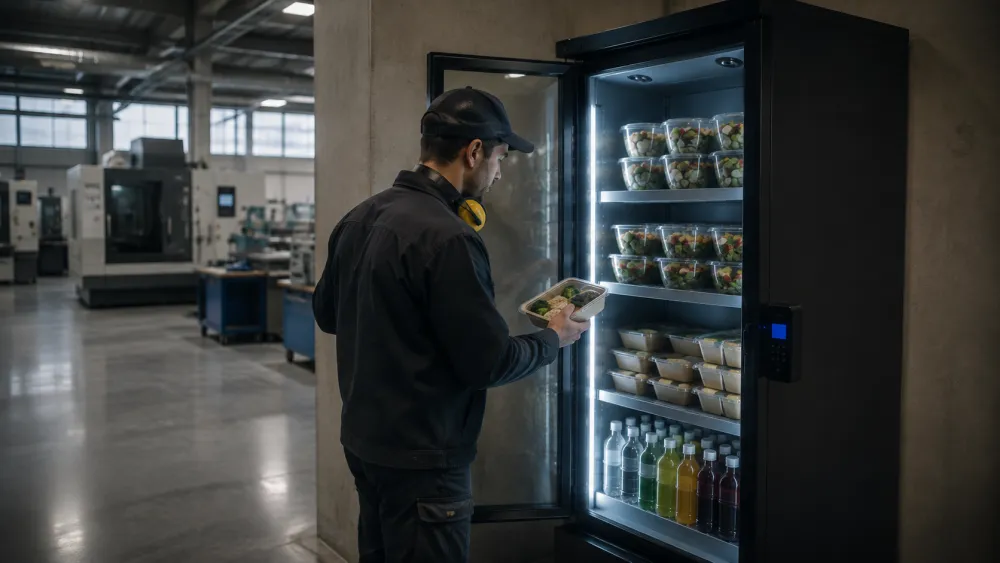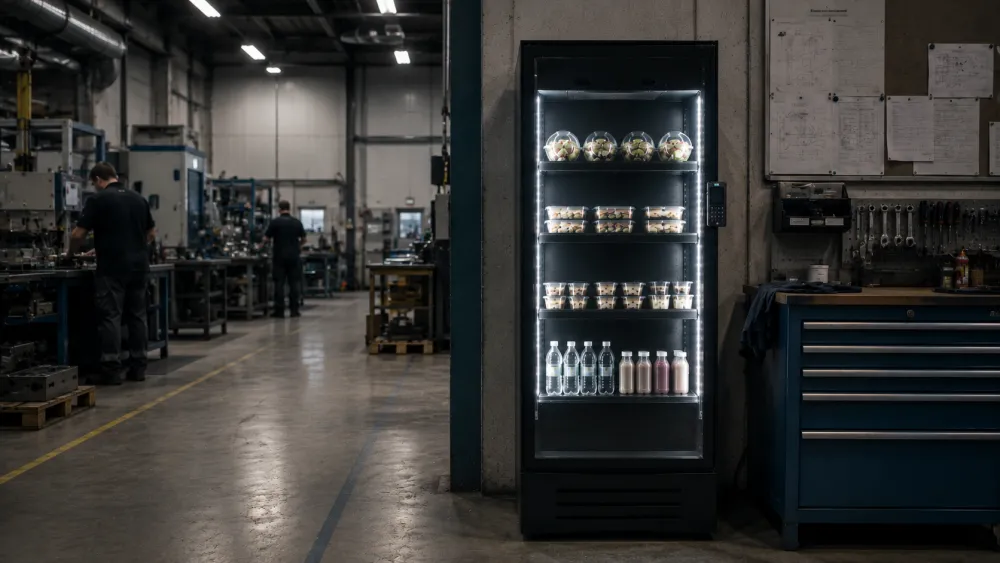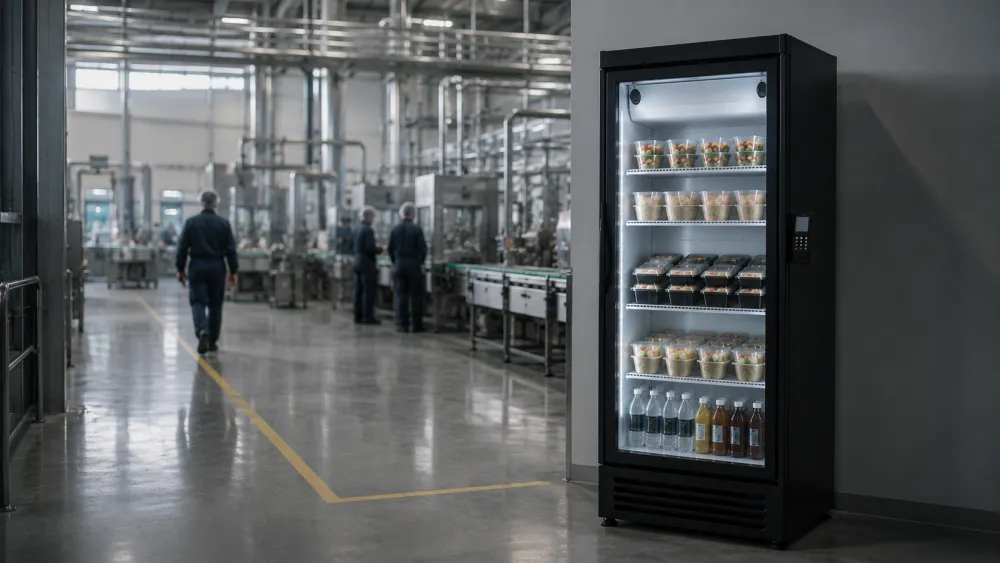
In manufacturing the break is fixed. It lasts half an hour, starts when the line stops and applies to everyone at once. Anyone who still has to go and find food in those thirty minutes is not taking a break. And as soon as you look at the late and night shifts, there is usually nothing left to find anyway.
A production break works differently from an office break: it is collective, short and cannot be moved. Anything that slows down the choice, such as a queue, a detour or an empty break room, comes straight off the rest time. Over time people just grab something from the machine and carry on working.
Then there is the shift pattern. A canteen open from eleven to two serves one of three shifts properly. The late shift gets the leftovers, the night shift gets the vending machine. A chilled cabinet has no opening hours and runs through all three shifts.
Put your shift roster next to what is open, and the picture is the same at most sites.
| Shift | What is open now | What happens then |
|---|---|---|
| Early shift | Nothing at the start, canteen from midday | People eat what they packed that morning |
| Day shift | Canteen or sandwich service | It works, because everything is set up for this shift |
| Late shift | Canteen closed, vending machine | Leftovers or dry snacks |
| Night shift | Nothing, not even off site | Bring something, or skip it |
The last two rows are the reason a cabinet goes in. The more your late and night headcount weighs, the faster it sells through. In the process industry, with safety zones and shutdowns, it is the same; see smart fridge for chemical plants. There is more in meals for the night shift.


That is exactly where you gain the most time. Anyone who walks to the break room during a fixed break and finds nothing loses half of those thirty minutes searching or in the car. With the cabinet on the route between the line and the break room, the choice is made in twenty seconds and the break stays a break.
That is the classic pattern: a canteen open from eleven to two while you run three shifts. The late shift eats what is left and the night shift has nothing. A cabinet covers exactly those hours, without anyone having to stay on to run it. That is why the first step is always to put your shift roster next to what is open now.
No, it only changes where the cabinet goes. In environments with clothing or hygiene rules it stands outside the production area: by the changing room, the break room or the entrance to the floor. The product stays wrapped until the break room, so nothing loose ends up in the area.
A break room with a microwave gives people a place to eat. Anyone who has brought nothing still sits at an empty table. The cabinet supplies the food: fresh and high-protein meals heated in that same microwave. Break room and cabinet need each other.
For a planned shutdown or works holiday, whoever restocks adjusts to it, so there is no full cabinet standing through an empty week. Rhythms like that are part of a manufacturing site, so build them into the restocking plan from the start.
Eight short questions about shifts, headcount and what is open now. We call you back with a proposal that starts from your own roster.
Takes about 90 seconds · no obligation · no contact details until the last step