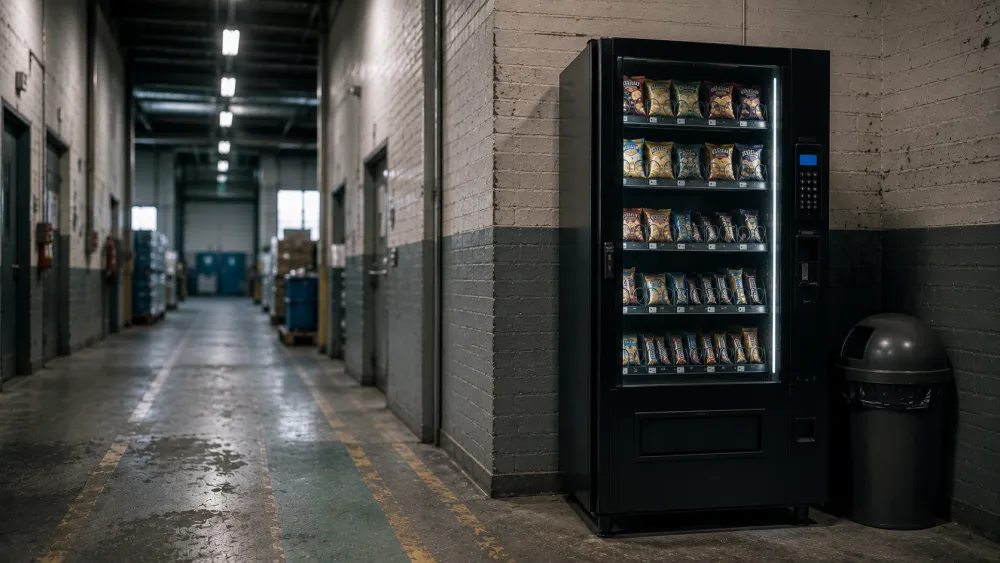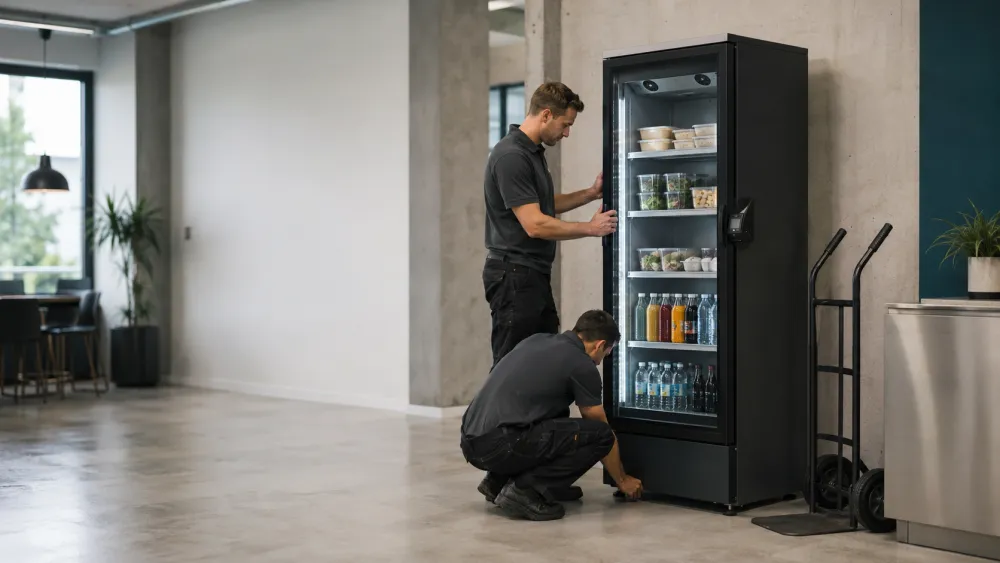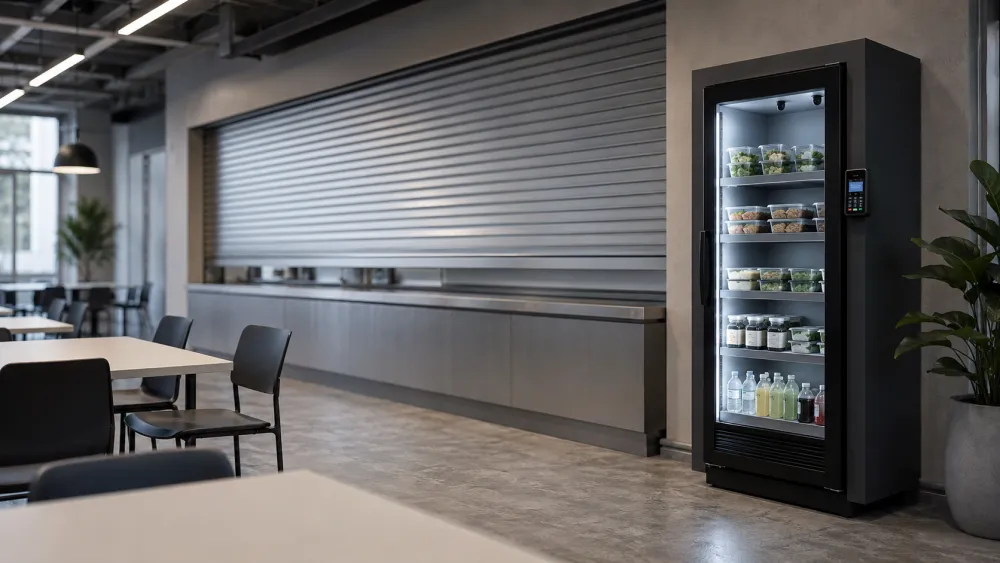
A free vending machine at work exists, but in vending, free means something specific: you do not buy the machine. Who pays for the products and what else is agreed is usually in the small print. Here it is in large print, next to the alternative: your own smart fridge, bought, rented or leased.
| An operator’s “free” machine | Your own smart fridge (buy, rent, lease) | |
|---|---|---|
| The unit | Free: the machine stays the operator’s | Purchase price, fee or instalments |
| Buying and stock | By the operator | By you or your supplier |
| Filling and maintenance | By the operator | Your team or supplier; warranty, remote assistance, software and parts from us |
| The food itself | Your people pay per product | Your people pay, or you subsidise; you set the prices |
| The margin | The operator’s | Yours |
Anyone looking for a smart fridge without buying is often really looking to rent. What renting and leasing involve is covered in renting a smart fridge.
An operator who places a machine for free earns from sales. That only works where enough people pass at enough times. On a site with a few dozen people who go home at five, it does not pay. After a while there is a half-empty machine, or the free offer quietly disappears.
That is why it pays to look at your site first. If it is not suitable for an operator, a fridge you own may still be: you decide on range and prices, and the sales per product show what works. What doing nothing costs in the meantime is worked out in business without a canteen.

If you want your people to pay nothing, you set that up on your own fridge. Free water, a meal for the night shift or a budget per employee are all possible, and you then pay for what is taken. Why employers do this is covered in food as an employee benefit.
For people who pay themselves, as in student housing, pricing matters most: a range priced too high stays on the shelf. How the cost is built up is in what a smart fridge costs.

Because they earn from what sells. At a site with enough footfall, sales cover the machine, the stock and the rounds. That is why any serious operator looks first at your headcount and your hours.
An operator sets prices per site to suit the audience; a range priced too high does not sell, and nobody gains from that. With your own fridge you set the prices, and you can lower them for your people with a subsidy per product.
Look at the range and the location first: that is often where the problem lies. With an operator, the term and notice should be fixed in advance, so nobody is stuck with a machine that does not work. With your own fridge, the sales per product quickly show where to adjust.
Yes, an agreement per site: where the machine stands, who has access, how payment works, what happens in a fault, and how term and notice are arranged. All of that should be clearly set out in the proposal.
With an operator, that is up to them. If you want to own the fridge, buying or leasing one from us is the direct route.
Eight short questions about your people and hours. We tell you which route suits your site: buying, renting or leasing, and what that means for your costs.
Takes about 90 seconds · no obligation · no contact details until the last step