With an automated retail machine, picking the machine is the easy part. The harder part is agreeing who fills it, who pays for the stock and whose phone rings when it is empty. Whether it is still running after three months depends on those agreements. They are set out below.
A half-empty vending machine rarely has a technical fault. Usually someone was given restocking on top of a job that was already full, and kept putting it off until nobody did it. The machine then gets blamed for a poor division of tasks. That task is exactly what an operator takes on. If the machine has to feed a site without a canteen, it matters even more: there, it is the only food around.
That is why we discuss the agreements first and the fridge second. Who buys the stock? Who carries the risk of what does not sell? Who notices that a product is not moving? Once that is clear, the choice of arrangement usually makes itself. If you would rather not buy the machine, read what renting means in practice.
It is the same fridge, which you can set up in three ways. They differ only in how much work stays with you, in an office just as much as in a manufacturing site with three shifts.
You buy the machine, set the range and prices yourself and keep the takings. Buying stock, filling and follow-up are done in-house; from us you get warranty, remote assistance, software and parts.
The unit is at your site for a fee or instalments. Otherwise it works as with buying: you choose the range and who restocks.
You buy or rent the fridge, and your caterer or a local supplier handles restocking under an agreement with you. Agree in advance who carries the risk of unsold products.
Not sure yet which arrangement suits you? It does not have to be decided in advance. In the site check you can tick “not sure yet”, and we will come back with a proposal based on your hours and headcount. Also considering a caterer or meal vouchers? They are compared side by side in food for employees.

Eight questions about your site: headcount, hours, what is there now and what you are looking for. Takes a minute and a half.
We call you back, go through the situation and tell you honestly whether it makes sense at your site, even if the answer is no.
Together we decide where the fridge goes and what goes in it: fresh, high-protein, halal, drinks or a mix.
The fridge is delivered and commissioned. After that, whoever restocks adjusts the range to what actually sells.

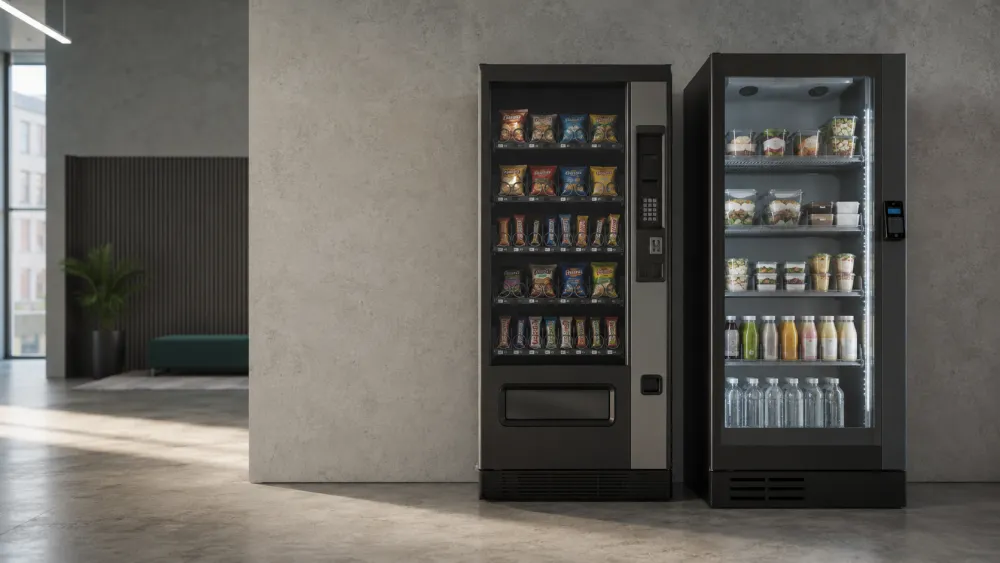
Automated retail is the umbrella term for any machine that sells products on its own. A smart fridge is a modern, fully chilled version of it: you open it with a badge, card or app, take what you need and payment happens automatically. The principle is the same. The difference is the chilling: it means fresh meals fit too, not just dry products.
If you buy or rent the unit, yes: you or your supplier buy the stock and you keep the margin. With an external supplier, agree in advance who carries the risk of unsold products. What works best depends on who at your site has time to follow it up.
Both are possible. Most sites have employees pay per product, sometimes at a price the company partly subsidises. Other companies set a budget per employee or make certain products free, such as water, fruit or a night-shift meal. A setting is all it takes; no other machine is needed.
A level spot on a route people use anyway, a power socket, and a contact person for delivery and commissioning. Nothing more. The fridge runs on mobile data, so your IT team does not need to get involved.
Yes. Access can be linked to a company badge, but does not have to be: with a bank card or app, anyone on site can open the fridge. At sites with lots of people coming and going, such as drivers, subcontractors and weekend shifts, that often counts most.
Eight short questions about your site and what you are looking for: buy, rent or lease, with your own team or a supplier. Based on that, we call you with a concrete proposal.
Takes about 90 seconds · no obligation · no contact details until the last step