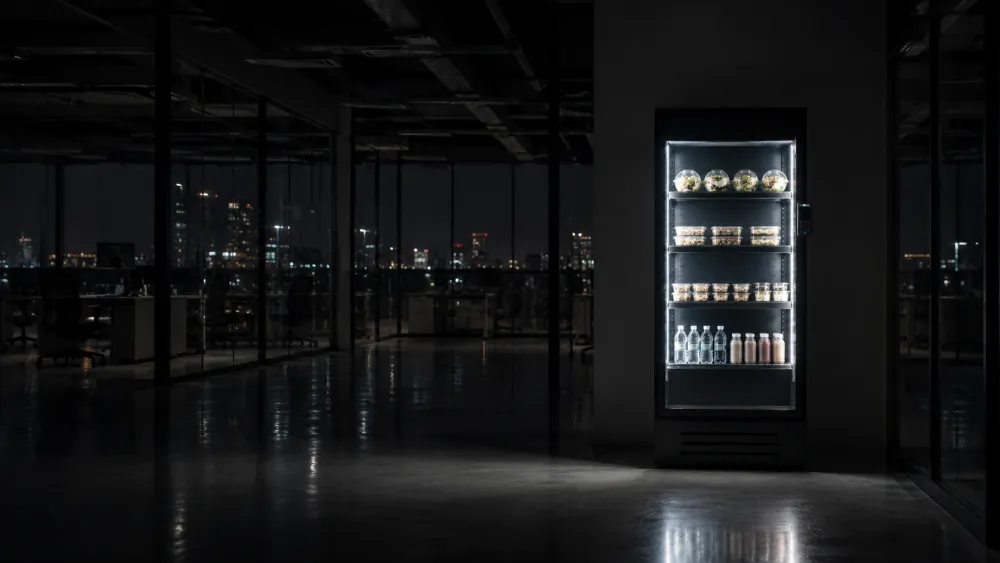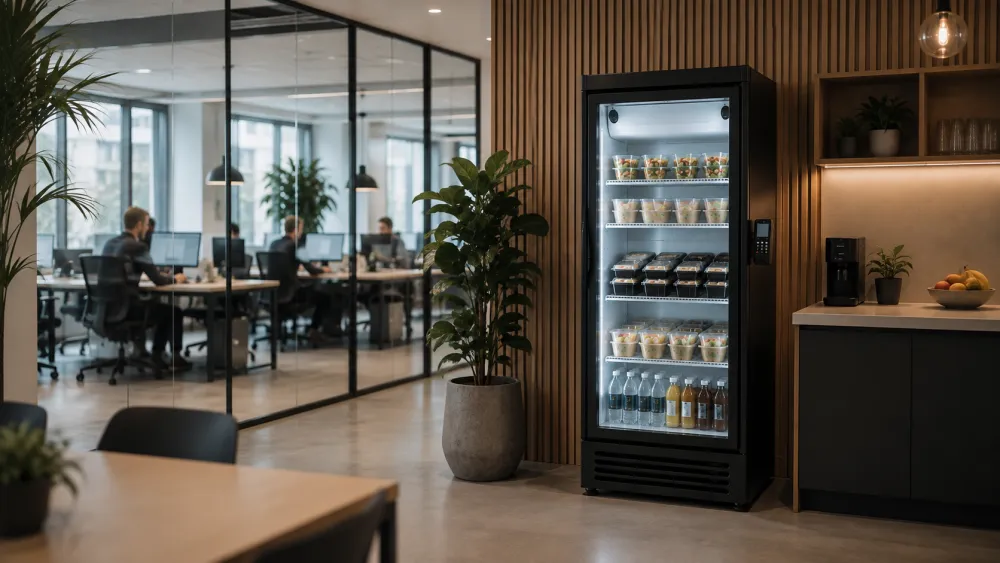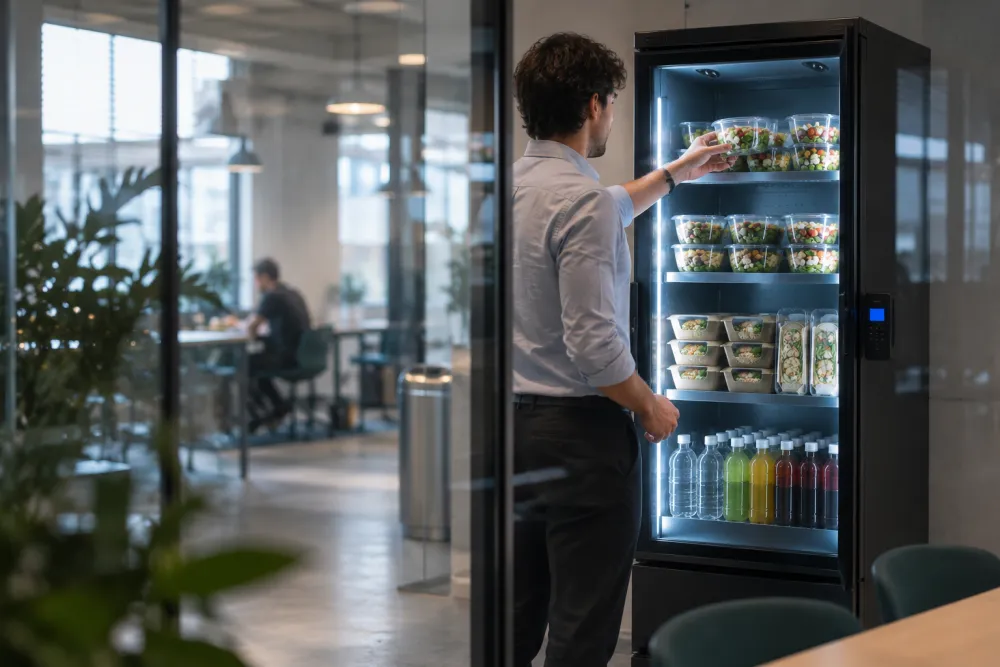
On Tuesday the office is full; on Friday a handful of people work there. A caterer delivers the same on both days, a canteen runs with the same crew on both days. A hybrid office needs a food offer that moves with attendance, without someone counting every morning how many people will turn up.
A canteen or caterer works with an expected number of meals. When that number changes from day to day, food is left over on quiet days and runs short on busy ones. That is why canteens come under pressure as soon as hybrid work spreads out the lunch peak; see an alternative to the staff canteen.
The second problem is who organises it. With fixed office days it is still predictable; with free choice of home-working days nobody knows in advance. Ordering based on who is coming tomorrow becomes a daily job for the office manager, and one that rarely comes out right. On the busy day it is gone by half past twelve; on the quiet day half of it is still there.
| Caterer to order | Canteen | Fridge restocked to consumption | |
|---|---|---|---|
| Follows attendance | If someone orders exactly right | Barely | Yes, to what really sells |
| Work for you | Ordering every day | Contract and management | Restocking, guided by sales data |
| Leftovers | Yours | Yours or the caterer’s | Few, because orders follow sales |
| Outside lunchtime | No | No | Yes |
The right-hand column is what we make. Daily delivery and a stocked fridge are compared in more detail in having meals delivered.

Which days is the office full, and are they fixed or do they change?
Fresh meals are restocked in step with when your people have lunch.
Anything close to its date comes out at the next restock, so order for the quieter days.
Sales per product and per day quickly show which day takes what, and the offer shifts with it.

In a shared building or a coworking space, attendance swings even more, because every company has different days. There the operator often sells to members directly; see a smart fridge for a coworking space. In your own office, the fridge is best placed next to the coffee corner; see office smart fridge.
What a fridge costs with changing attendance depends on the average across the week, not on the busiest day. The factors are in what a smart fridge costs.
Yes. With fixed busy days, the restocking rhythm is set around them. If the days change, it is adjusted to what actually sells each day; the sales per product show you.
Anything close to its date comes out at the next restock. So order for the weekend on the basis of a quiet Friday, and let the sales data tell you how quiet it really is.
That depends on how many people are in on those days and what is nearby. An office with three full days on a business park without shops often reaches enough turnover. For an office in town, it is less obvious.
Anyone in the office can buy something and take it along. The offer is aimed at the day itself, though, not at dinner for the whole week. That is also why it is sized to consumption: on busy days, the people working there that day come first.
Yes. An ordered lunch for a team day and a fridge for the other days go well together. Just factor the team days into the restocking order.
Eight short questions about your office and attendance. We will tell you whether an offer that moves with it suits you.
Takes about 90 seconds · no obligation · no contact details until the last step