Anyone with an allergy needs to be able to read what they are taking before they pay. With a spiral machine, they only see the label once the product has dropped. With a buffet or a sandwich platter, often not at all. Below: how that works in a chilled fridge, and where the limit lies of what a sealed pack promises.
A spiral machine shows a product behind glass, with a slot number. The label is on the back or too small to read. Anyone in doubt buys on the off-chance or buys nothing. With a sandwich platter or a meeting buffet there is often no label at all.
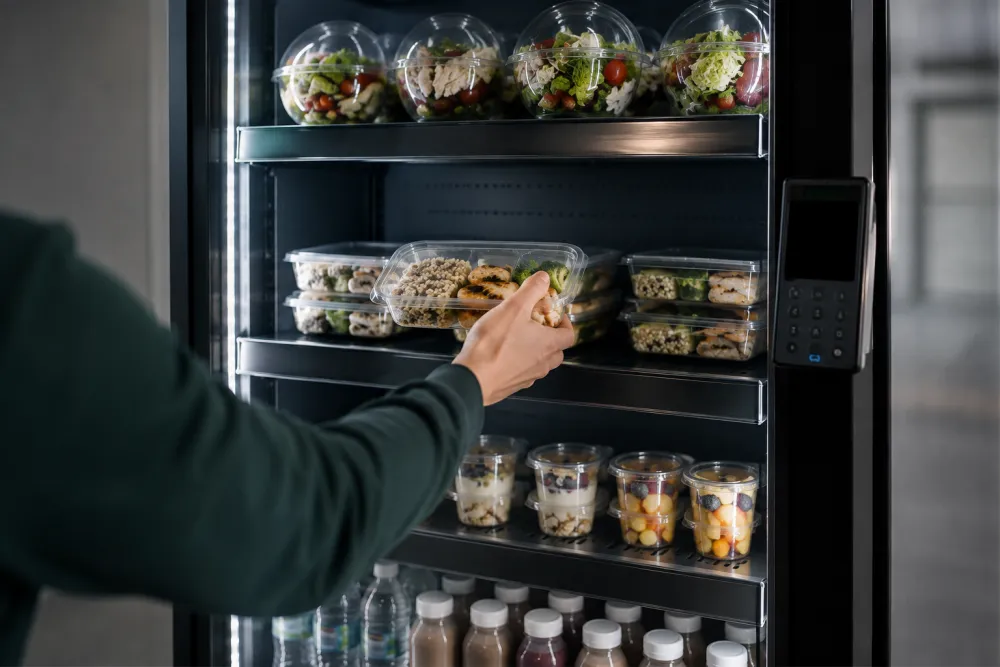
In a chilled fridge you take the product in your hand, turn it over and read what is in it. Only when the door closes is what you took charged. For someone with an allergy, that decides whether they can choose anything at all.
| What it means | |
|---|---|
| Yes | A fridge where everyone takes the product in hand and reads the label before paying; individually packed products that stay sealed until use. |
| No | No allergen-free production, no guarantee that traces are absent, no medical or nutrition advice. What is on the label comes from the producer and your supplier. |
| On request | Ask about specific needs on the call; we will say honestly what the fridge can and cannot do for you. |
The same principle of marking on the pack itself applies to halal, kosher and vegan; see halal vending.

For anyone eating gluten-free, lactose-free or nut-free, the same applies: the label on the pack is the source, not a sign on the fridge or what a colleague says. Do not promise a fixed diet line on the fridge, so nobody relies on a promise instead of what is on the pack.
At meetings the difference is often greatest. Faced with an unlabelled sandwich platter, anyone with an allergy politely passes. With a few packed products from the fridge, everyone at the table can choose, including visitors you do not know.
How allergens fit among the other choices around staff food is covered in food for staff. How the cold chain and dates are followed up is covered in vending food safety.

In care settings there is an extra limit: the fridge is not meant for patient meals; see a smart fridge for care facilities.
Which of the allergens that must be declared are in the product.
Energy, protein, fat, sugars and salt per portion or per hundred grams.
Until when the product is good. Whoever restocks takes it out before that date.
We do not give nutrition or health advice. Nutrition and allergens are on every pack; for individual questions, a dietitian or your occupational health doctor is the right place to go. What the fridge costs is covered in what a smart fridge costs.
No. What the fridge guarantees is that everyone can read the label before paying and that products stay sealed until use. Allergen-free production or the absence of traces is not guaranteed.
What a product contains is on the label. Whether gluten-free options are in the range depends on what you and your supplier stock.
By opening the door and taking the product in their hand. Only what has been taken out is charged when the door closes, so looking and putting back is possible as often as needed.
Then the label changes too. That is why the pack stays the source, even for people who know a product and have been taking it for months. Read again when in doubt, and certainly when the pack looks different from before.
We make no legal statement about that. What the fridge does is make the information readable before purchase. How you as an employer handle allergies at work is best discussed with your health and safety adviser.
Eight short questions about your site and your team. On the call we discuss which needs there are and what the fridge can do for them.
Takes about 90 seconds · no obligation · no contact details until the last step